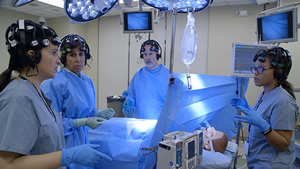
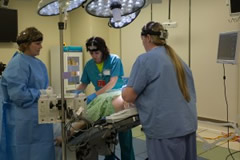
The mission of Team Neurodynamics is to develop and implement quantitative information-based systems to support teams performing in complex natural healthcare and military situations.
We approach this by isolating micro scale patterns in EEG and other physiologic data streams to explain how different organizational properties contribute to recognizable teamwork behaviors at macro scales.
Neurodynamic organizations are emerging as a fundamental property of teamwork. Increases are seen with healthcare teams when there is a fire in the operating room, or with submarine navigation teams when there is a danger of grounding. Increased neurodynamic organization is almost always a sign that a team, and one or more of its team members, is in difficulty.
In this presentation we will explore how we can begin to ‘make sense’ of the information in these data streams that are being recorded from teams at increasingly higher resolutions, and what can we expect to learn about teams through the application of different representations, transformations and aggregations of information.
read more
The aim of this study was to use the same quantitative measure and scale to directly compare the neurodynamic information/organizations of individual team members with those of the team.
read more
Objective: To determine whether a dynamical analysis of neural and communication data streams provide fine-grained insights into healthcare team debriefings.
read more
The information within the neurodynamic data streams of teams engaged in naturalistic decision making was separated into information unique to each team member, the information shared by two or more team members, and team-specific information related to interactions with the task and team members.
read more
In this chapter we highlight a neurodynamic approach that is showing promise as a quantitative measure of team performance.
read more
We describe efforts to make humans more transparent to machines by focusing on uncertainty, a concept with roots in neuronal populations that scales through social interactions.
read more

Quantitatively Compare the Contributions of Each Person to the Organization of the team.


What are Team Neurodynamics?
Team Neurodynamics is the science of applying the measurement of neurophysiologic indicators to the modeling of teamwork and is the study of the changing rhythms and organizations of teams from the perspective of neurophysiology. As a discipline, team neurodynamics is located at the intersection of collaborative learning, psychometrics, complexity theory and neurobiology with the resulting principles and applications both drawing from and contributing to these specialties.


Neurodynamics organizations
Select below for more information
publications
Frontiers in Human Neuroscience
Journal of Cognitive Engineering and Decision Making
Human Factors and Ergonomics in Health Care
Tracing Neurodynamic Information Flows in Healthcare Teams during Simulation Training
Teaching Machines to Recognize Neurodynamic Correlates of Team and Team Member Uncertainty
Neurodynamic and Communication Analysis of Healthcare Teams during Simulation Debriefing.
Human Factors and Ergonomics Society
Team Dynamics Over Time, Vol. 18
The Journal of the Human Factors and Ergonomics Society
A Team's Neurodynamic Organization is More than the Sum of its Member
Low Level Predictors of Team Dynamics: A Neurodynamic Approach
Neuroergonomics: Quantitative Modeling of Individual, Shared, and Team Neurodynamic Information